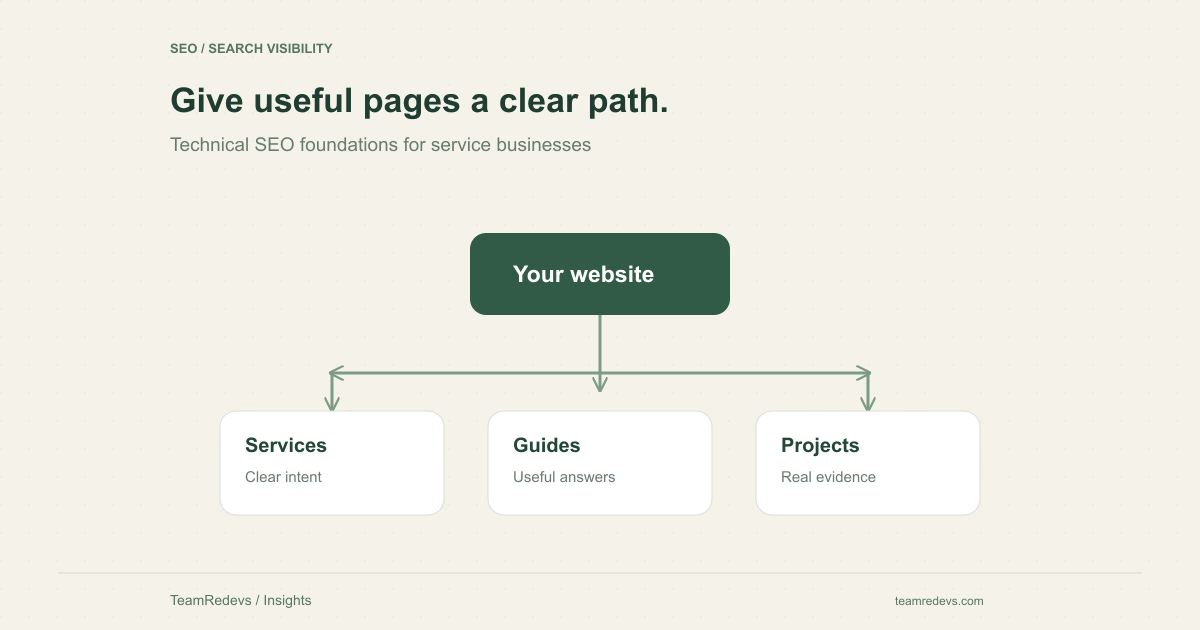
Technical SEO helps search engines access and understand a website, but it cannot replace a useful offer or substantive service information. For a service business, the first audit should connect technical checks to the pages that help a potential customer make a decision. Before adding another batch of articles, check whether the existing pages can be found, understood, and used.
First, follow a potential customer to the right service page
Choose one enquiry you want the website to support. A business looking for a web application partner needs different information from someone researching a small marketing-site update. The corresponding page should explain the problem, likely scope, process, and next step in language that matches that need.
Separate services when they answer meaningfully different questions. Do not create several near-identical pages by replacing a city name or a keyword in the heading. For a Jaipur-based studio working remotely, location information should describe the actual business and working arrangement rather than imply offices that do not exist.
Check access, indexing signals, and canonical URLs
Open important pages as a visitor and inspect their response status and rendered content. Confirm that public pages are not accidentally marked noindex, canonical links use the intended production domain, and deliberate URL changes redirect consistently. Keep admin and private areas separate from the pages intended for discovery.
Treat crawler access and indexing as related but different checks. A sitemap can help search engines discover URLs; it does not guarantee that they will be indexed. Include the canonical public pages you actually want evaluated, and avoid redirect destinations, error pages, or drafts in that list. Google’s sitemap overview
- Does the public URL return the intended content with a successful response?
- Is its canonical URL consistent with internal links and the sitemap?
- Are production indexing instructions intentional?
- Do old URLs redirect to the most relevant replacement?
Connect articles to services with a reason to click
An internal link should help the reader move from a question to a relevant next step. A build-or-buy guide can point to software development and discovery services. An onboarding audit can point to UI/UX design. The wording should explain the destination rather than repeatedly inserting the same keyword into unrelated paragraphs.
Work in both directions. A service page can link to a useful guide that explains a difficult buying decision, while the guide can link back to the service scope. This gives readers context without forcing every article to repeat the sales page. Our website launch checklist illustrates how content publishing and service enquiries belong in the same review. Business website launch checklist
Make metadata and structured data match the page
Write a distinct title and summary for each important page. The title should identify the page’s actual subject, while the summary should explain why someone would read it. Avoid assigning every page the same broad list of services; that makes the information less useful to both visitors and editors.
Structured data describes content in a machine-readable form. It should reflect the visible page and use a supported type correctly; adding it does not guarantee a rich search result. Do not invent reviews, ratings, people, locations, or product claims to populate a schema template. Google’s introduction to structured data
For AI visibility, make answers clear and verifiable
Begin a guide with a direct answer, then explain the conditions, examples, and tradeoffs. Identify the organization publishing it, link to source material where needed, and distinguish an available product from an upcoming one. These habits make the content easier for a person to assess and provide clearer information for systems processing the page.
Google’s guidance for its AI search features says there are no additional technical requirements beyond the usual search requirements and no special schema needed for inclusion. An llms.txt file may offer a supplementary plain-text reference, but it should not be presented as a Google inclusion requirement or a promise of AI citations. Google guidance on AI search features
Prioritize fixes by the journey they affect
Resolve a blocked service page or a broken enquiry path before polishing a low-priority metadata variation. Then monitor discovery, relevant visits, and qualified enquiries over time. Keep a change log so the team can connect improvements with evidence rather than attributing every fluctuation to the latest edit.
TeamRedevs’ SEO service covers technical audits, on-page structure, content recommendations, and measurement planning. A useful starting brief includes your important services, existing pages, and the types of enquiries the business can serve well. Explore our SEO services
Apply this to your product
Start with one user journey or integration in your current product. Document the expected behavior, review the linked source material, and agree on the checks needed before release. The right implementation depends on your existing architecture and operational requirements.
Further reading
MORE FROM OUR TEAM
Related Engineering Insights
Cloud-Native Application Modernisation in India: A Practical Guide for Growing Businesses
Plan cloud-native modernisation with a practical guide to modular architecture, APIs, observability, security and phased migration for Indian businesses.
Custom Logistics Software for Nagpur Businesses: Fleet, Warehouse and Supply Chain Management
Explore custom logistics software for Nagpur businesses, from fleet and warehouse workflows to shipment tracking, integrations and operational dashboards.
Hotel Website Development in Jaipur: Direct Booking Platforms, Guest Experience and Digital Growth
Learn how Jaipur hotels and hospitality businesses can improve direct bookings with fast websites, booking journeys, CRM integrations and mobile-first UX.