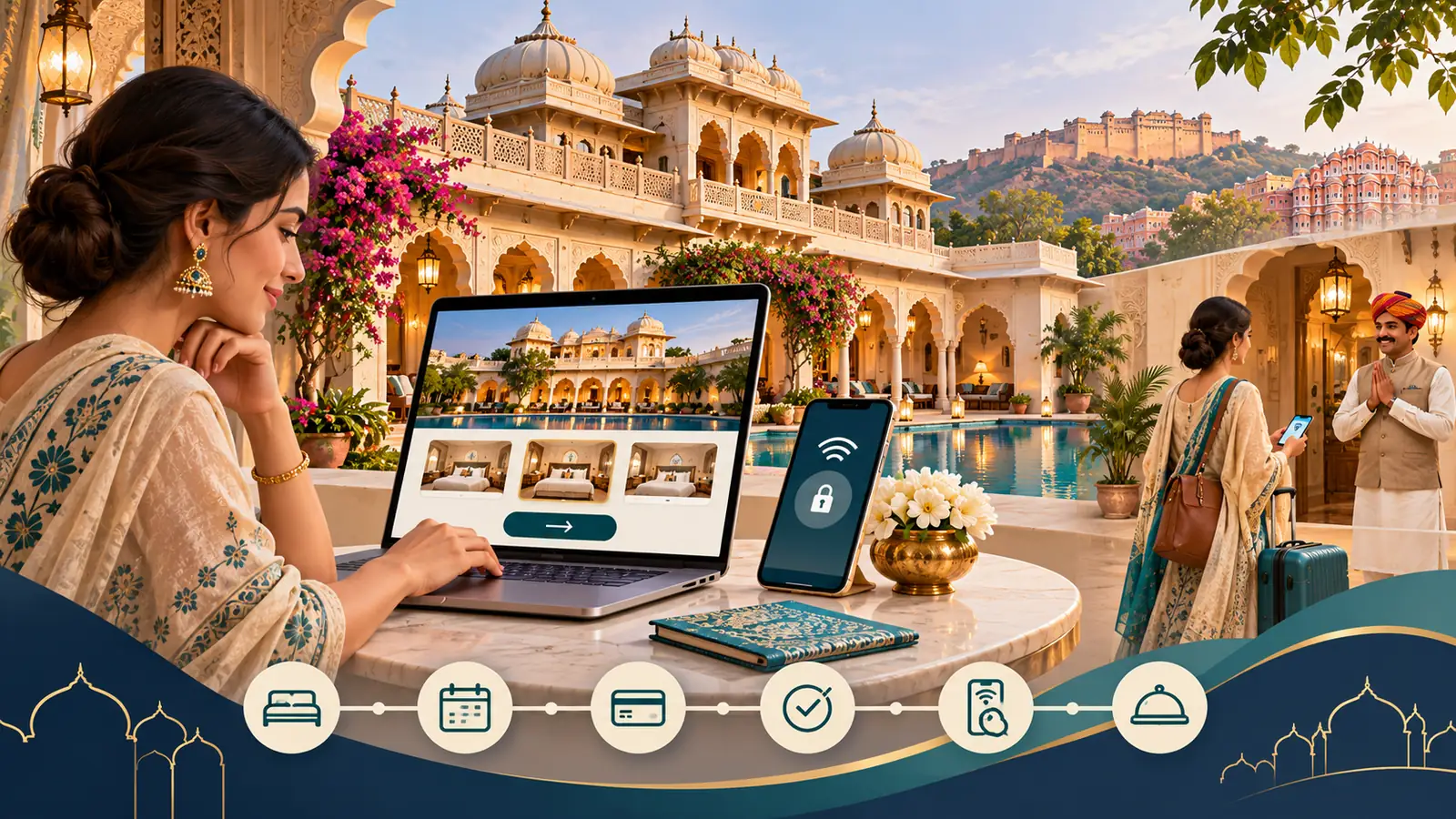
Jaipur attracts travellers interested in heritage properties, cultural experiences, weddings, hospitality and business travel.
Overview
For hotels and hospitality businesses, the online experience often becomes an important part of a customer's booking decision.
A visitor may discover a property through Google, explore its rooms, compare amenities, check availability and decide whether to make a reservation.
If the website is outdated, difficult to navigate or does not provide a clear booking journey, potential customers may leave without completing an enquiry.
A modern hotel website should do more than display photographs and contact information.
It should help visitors understand the property, explore available services, make enquiries and complete suitable booking actions.
For hotels, resorts and hospitality businesses in Jaipur, investing in a well-designed digital platform can create a stronger direct relationship with customers.
In this guide, we explore the important features of a modern hotel website, booking integrations, mobile experiences and practical development considerations.
1. Why Hotels in Jaipur Need More Than a Basic Website
A basic website may contain:
- Hotel photographs.
- Room descriptions.
- Contact details.
- Location information.
- An enquiry form.
However, customers increasingly expect a more complete digital experience.
They may want to:
- View available rooms.
- Compare accommodation options.
- Check amenities.
- Explore wedding or event facilities.
- Understand cancellation policies.
- Submit booking enquiries.
- Contact the property quickly.
A well-designed hotel website should make these tasks straightforward.
The objective is not simply to create a visually attractive website. It is to help a potential guest move from discovery to a clear next action.
2. Essential Features of a Modern Hotel Website
A. Responsive website design
A hotel website should work properly across smartphones, tablets and desktops.
Important considerations include:
- Readable room descriptions.
- Clear photographs.
- Easy-to-use navigation.
- Accessible booking forms.
- Clickable contact information.
- Properly displayed pricing information.
Mobile usability is particularly important because visitors may explore accommodation options while planning their journeys.
B. Room and property listings
Each accommodation option should have its own detailed presentation.
Include:
- Room category.
- Photographs.
- Occupancy information.
- Amenities.
- Relevant policies.
- Available services.
- Pricing information where appropriate.
Avoid using generic room descriptions that make different accommodation options appear identical.
C. Online booking functionality
A suitable booking system may allow visitors to:
- Select check-in and check-out dates.
- Choose the number of guests.
- View available room types.
- Review applicable pricing.
- Enter guest information.
- Complete an enquiry or booking.
- Receive confirmation.
The booking workflow should clearly explain what is confirmed and what requires additional verification.
D. Property and experience pages
Hospitality websites can also include dedicated pages for:
- Wedding venues.
- Conference facilities.
- Restaurants.
- Spa services.
- Local experiences.
- Group accommodation.
- Corporate events.
This helps the business communicate its full offering rather than focusing only on room bookings.
3. Direct Booking Website vs Relying Only on Travel Platforms
Online travel agencies can provide discovery and booking opportunities.
However, a hotel should also evaluate whether a direct booking experience would be valuable for its business.
A direct website gives the property greater control over its presentation, enquiry process and customer communication.
| Area | Third-party travel platform | Own hotel website |
|---|---|---|
| Brand presentation | Platform-controlled format | Customised experience |
| Property content | Platform-defined structure | Full content control |
| Enquiry workflow | Platform-dependent | Can be customised |
| Customer communication | Subject to platform capabilities | Direct integration options |
| Booking system | Platform-provided | Can connect with suitable booking software |
| Analytics | Platform reporting | First-party website analytics |
An independent website does not automatically guarantee more bookings.
Its value depends on discoverability, customer trust, competitive pricing, usability and the effectiveness of the booking process.
A balanced strategy can use both third-party discovery platforms and a well-designed direct website.
4. Building a Hotel Booking Engine
A booking engine is one of the most important technical components of a hotel website.
It connects the visitor-facing interface with availability and reservation information.
A typical architecture includes:
- Room inventory.
- Availability calendar.
- Guest information.
- Rate management.
- Reservation records.
- Payment integration.
- Confirmation notifications.
- Cancellation workflows.
Example booking journey
A visitor chooses dates and selects a room.
The application checks availability through the booking backend.
If a room is available, the visitor proceeds to the reservation process.
The system should verify availability again before confirming the booking to prevent conflicting reservations.
For properties using existing property-management systems, the website should connect through supported APIs rather than maintaining a separate, inconsistent inventory.
5. Hotel CRM and Property Management Integrations
A website becomes more useful when it connects to the hotel's operational systems.
Possible integrations include:
Property Management System (PMS): Room availability, reservations and guest records.
Channel Manager: Coordination of inventory across supported booking channels.
CRM: Customer enquiries, guest communication and follow-ups.
Payment Gateway: Secure payment processing.
Email and SMS: Booking notifications and enquiry updates.
Analytics: Website activity, booking funnel and enquiry measurement.
The exact integration requirements depend on the property's existing software.
Before development, document which system is responsible for each type of information.
6. UI/UX Design for Hospitality Websites
Hospitality websites depend heavily on visual presentation and trust.
The interface should help visitors understand the experience offered by the property.
Important design considerations include:
- High-quality, authentic photography.
- Clear room comparison.
- Visible location information.
- Transparent booking policies.
- Accessible typography.
- Consistent visual identity.
- Simple enquiry forms.
- Clear contact details.
For a heritage hotel, the visual identity might communicate architecture, history and local character.
For a business hotel, the emphasis might be on location, amenities, convenience and corporate accommodation.
The interface should reflect the actual property rather than relying on generic hospitality templates.
7. Technical SEO for Jaipur Hotel Websites
A hotel website should be discoverable for searches relevant to its property and services.
Useful SEO work includes:
Location-specific pages
Create meaningful pages for the hotel's actual offerings and relevant areas.
For example:
- Heritage hotel accommodation in Jaipur.
- Wedding venue facilities.
- Corporate event accommodation.
- Restaurant and dining experiences.
Do not create repetitive location pages with nearly identical content.
Local business information
Keep the property's name, address, contact information and opening details accurate.
Where applicable, implement suitable structured data such as Hotel, LodgingBusiness, Organization and BreadcrumbList, following Google's supported structured-data guidance.
Image optimisation
Hotel websites often contain large photographs.
Compress images, use appropriate responsive formats and avoid loading every photograph immediately.
Core Web Vitals
Google recommends these good-experience thresholds:
| Metric | Recommended threshold |
|---|---|
| LCP | 2.5 seconds or less |
| INP | Less than 200 ms |
| CLS | Less than 0.1 |
A faster, more stable booking experience can help visitors navigate the website more comfortably.
8. Why Mobile Apps May Be Useful for Hospitality Businesses
Some hospitality businesses may benefit from a mobile application, particularly when they need ongoing guest engagement or additional operational functionality.
Possible features include:
- Digital check-in information.
- Reservation details.
- Guest service requests.
- Property notifications.
- Loyalty programmes.
- Local experience recommendations.
- Event schedules.
However, not every hotel needs a dedicated app.
For many properties, a responsive website and an efficient booking experience should come first.
Mobile application development becomes more valuable when the business has a clear recurring user requirement.
9. A Practical Digital Roadmap for Jaipur Hospitality Businesses
A phased approach can help hotels avoid unnecessary investment.
| Phase | Development priority |
|---|---|
| 1 | Responsive website and property presentation |
| 2 | Booking enquiry and reservation integration |
| 3 | PMS, CRM and payment integrations |
| 4 | Technical SEO and analytics |
| 5 | Guest portal or mobile application, where justified |
Start with the most important customer journey.
Measure website enquiries, booking completion and customer behaviour before expanding functionality.
10. How TeamRedevs Helps Jaipur Hospitality Businesses
TeamRedevs is headquartered in Jaipur and works with businesses locally, across India and internationally.
Its capabilities include:
- Custom website development.
- Web application development.
- Ecommerce and booking platform development.
- UI/UX design.
- API integrations.
- Mobile application development.
- Technical SEO.
- Digital strategy.
For a hospitality business, these services can support a property website, reservation experience, guest portal or integrated digital platform.
TeamRedevs approaches projects through discovery, planning, development and ongoing improvement.
Planning a hotel website or booking platform in Jaipur?
Explore TeamRedevs Web Development or discuss your requirements.
Conclusion
For Jaipur's hospitality businesses, a website should function as more than a digital brochure.
It should communicate the property's identity, present its services clearly and provide a straightforward journey for potential guests.
A modern booking experience, suitable software integrations, mobile-first design and technical SEO can help build a stronger digital foundation.
The right solution depends on the property, its customers and the way reservations are managed.
Frequently Asked Questions
1. Why does a hotel need a professional website?
A professional website helps hotels present their property, communicate services, display accommodation options and receive direct enquiries.
2. Can a hotel website include online booking?
Yes. It can connect to a booking engine that manages availability, reservations, guest information and supported payment workflows.
3. Can a hotel website integrate with a PMS?
Yes. Where supported APIs are available, the website can integrate with property-management systems to synchronise relevant booking and inventory information.
4. Should a Jaipur hotel develop its own mobile app?
Only when recurring guest requirements justify it. A responsive website and booking platform are often the more practical first step.
5. How can hotels improve direct bookings?
Improve website usability, property information, booking clarity, mobile performance, search visibility and customer communication.
6. Does TeamRedevs develop hotel booking websites?
TeamRedevs provides custom website, web application, API integration and mobile application development services that can support hospitality booking requirements.
Internal links
Apply this to your product
Start with one user journey or integration in your current product. Document the expected behavior, review the linked source material, and agree on the checks needed before release. The right implementation depends on your existing architecture and operational requirements.
Further reading
MORE FROM OUR TEAM
Related Engineering Insights
Cloud-Native Application Modernisation in India: A Practical Guide for Growing Businesses
Plan cloud-native modernisation with a practical guide to modular architecture, APIs, observability, security and phased migration for Indian businesses.
Custom Logistics Software for Nagpur Businesses: Fleet, Warehouse and Supply Chain Management
Explore custom logistics software for Nagpur businesses, from fleet and warehouse workflows to shipment tracking, integrations and operational dashboards.
Flutter 3.50 for Business Apps: New Features, Upgrade Considerations and What to Know
Explore Flutter 3.50's native interop, accessibility and performance updates, plus what Indian businesses should review before upgrading their mobile apps.