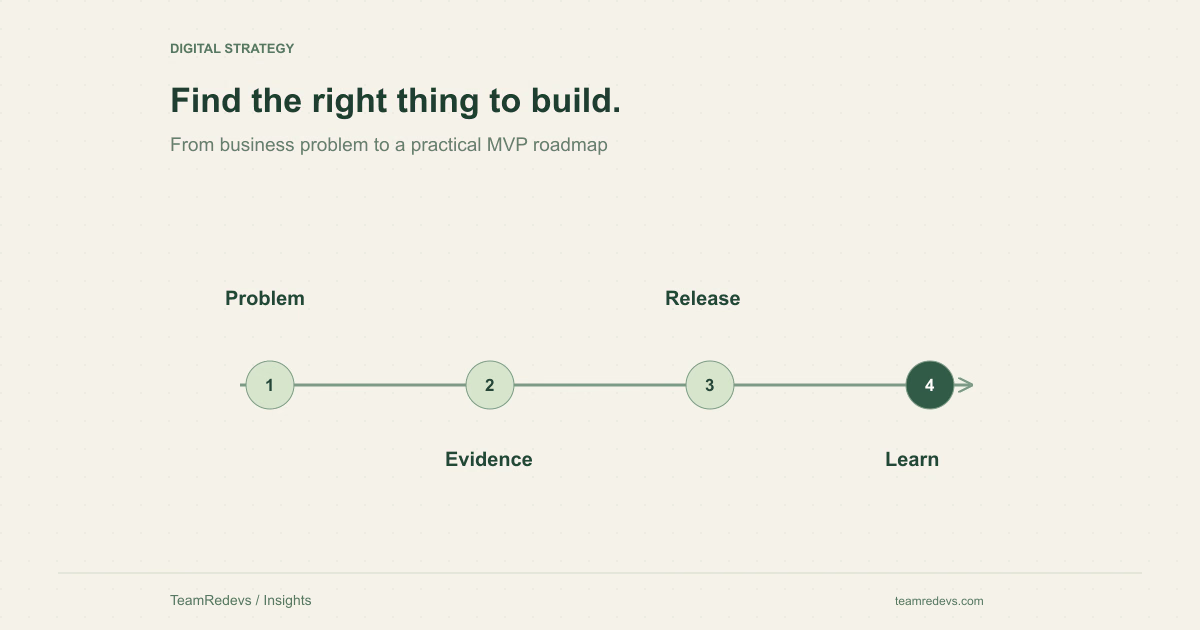
Product discovery turns an uncertain business goal into a better-informed decision about what to build. An MVP roadmap then sequences the smallest useful release and the evidence needed to decide what comes next. The purpose is to reduce avoidable uncertainty before development expands—not to produce a long document that makes an untested idea look settled.
Replace the feature request with a problem statement
A request such as we need a customer portal describes a possible solution. Ask what is difficult today, who experiences the problem, and what a better outcome would look like. A more useful statement might be that customers cannot see the status of a service request and repeatedly contact staff for updates. That opens several options beyond building a large portal.
The GOV.UK discovery guidance emphasizes understanding users and the problem before committing to building a service. Its public-service context differs from a commercial product, but the distinction between investigating a problem and starting implementation is a useful planning reference. GOV.UK guidance on the discovery phase
Map the current journey and its constraints
Follow a representative request from intake to resolution. Identify the person responsible at each step, where the authoritative record lives, and which handoffs create delays or uncertainty. In the portal example, the problem might begin with staff updating several spreadsheets rather than with customers lacking a login.
Record constraints that would change the solution: an existing system that cannot be replaced, a contractual integration requirement, a small support team, or users who work with unreliable connectivity. Keep known constraints separate from assumptions that have not been verified. This helps prevent a preferred tool from becoming a requirement without a reason.
Test the assumption that could invalidate the plan
Rank uncertainties by consequence. If customers would not use a separate portal, a clickable prototype and a few task-based sessions may be more informative than building account settings. If the critical external API cannot provide status updates, a technical spike may need to happen before visual design expands.
Give each investigation a decision: proceed, revise, choose a simpler option, or stop. A prototype should answer a question rather than merely demonstrate activity. Keep observations with the decision so the next team member can understand why the roadmap changed.
- Desirability: do users need and understand the proposed journey?
- Feasibility: can essential integrations and device capabilities work?
- Operability: can the team support and maintain the service?
- Business fit: does the outcome justify the effort and ongoing ownership?
Scope one complete journey for the MVP
For the service-request example, a useful first release might let a customer submit a request, receive a reference, inspect the current status, and understand what happens next. Staff need a reliable way to update that status. The release can be narrow while still covering the essential handoff and support path.
Defer features that do not help test the central outcome, such as advanced personalization or extensive reporting. Do not defer the basics that make the workflow trustworthy: appropriate access, understandable failures, recoverable data, and an owner for support. Minimal scope is not the same as an incomplete operational journey.
Write release criteria before filling the roadmap
Define what the team must be able to demonstrate before release. A customer can find a request using the intended account; staff can update its status; an unauthorized person cannot view it; and an interrupted submission has a clear recovery path. These criteria make the scope testable without prescribing every implementation detail.
Add a measurement plan that reflects the original problem. In this illustrative case, the team could observe whether customers find status information and whether repeat status enquiries change. Decide how to interpret the evidence before collecting it, and avoid promising a percentage improvement without a baseline.
Build a roadmap that leaves room to learn
Use stages tied to decisions: validate the core journey, deliver a usable release, observe real usage, then prioritize the next constraint. Keep estimates separate from commitments until dependencies and scope are understood. A roadmap should communicate direction and uncertainty clearly enough for stakeholders to make informed choices.
TeamRedevs’ digital strategy service helps teams with discovery, product scope, technology recommendations, and delivery planning. Bring the business problem, examples of the current workflow, and the constraints that matter most. Explore digital strategy and discovery
Discovery may also show that a purchased tool or a small integration is sufficient. Use our build-or-buy guide before treating custom development as the only possible outcome. Custom software versus off-the-shelf tools
Apply this to your product
Start with one user journey or integration in your current product. Document the expected behavior, review the linked source material, and agree on the checks needed before release. The right implementation depends on your existing architecture and operational requirements.
Further reading
MORE FROM OUR TEAM
Related Engineering Insights
Cloud-Native Application Modernisation in India: A Practical Guide for Growing Businesses
Plan cloud-native modernisation with a practical guide to modular architecture, APIs, observability, security and phased migration for Indian businesses.
Custom Logistics Software for Nagpur Businesses: Fleet, Warehouse and Supply Chain Management
Explore custom logistics software for Nagpur businesses, from fleet and warehouse workflows to shipment tracking, integrations and operational dashboards.
Hotel Website Development in Jaipur: Direct Booking Platforms, Guest Experience and Digital Growth
Learn how Jaipur hotels and hospitality businesses can improve direct bookings with fast websites, booking journeys, CRM integrations and mobile-first UX.