Overview
A telecommunications failure affecting the US air-traffic control network triggered an extraordinary aviation disruption on Friday, 13 November 2026, forcing the Federal Aviation Administration (FAA) to halt departing flights nationwide.
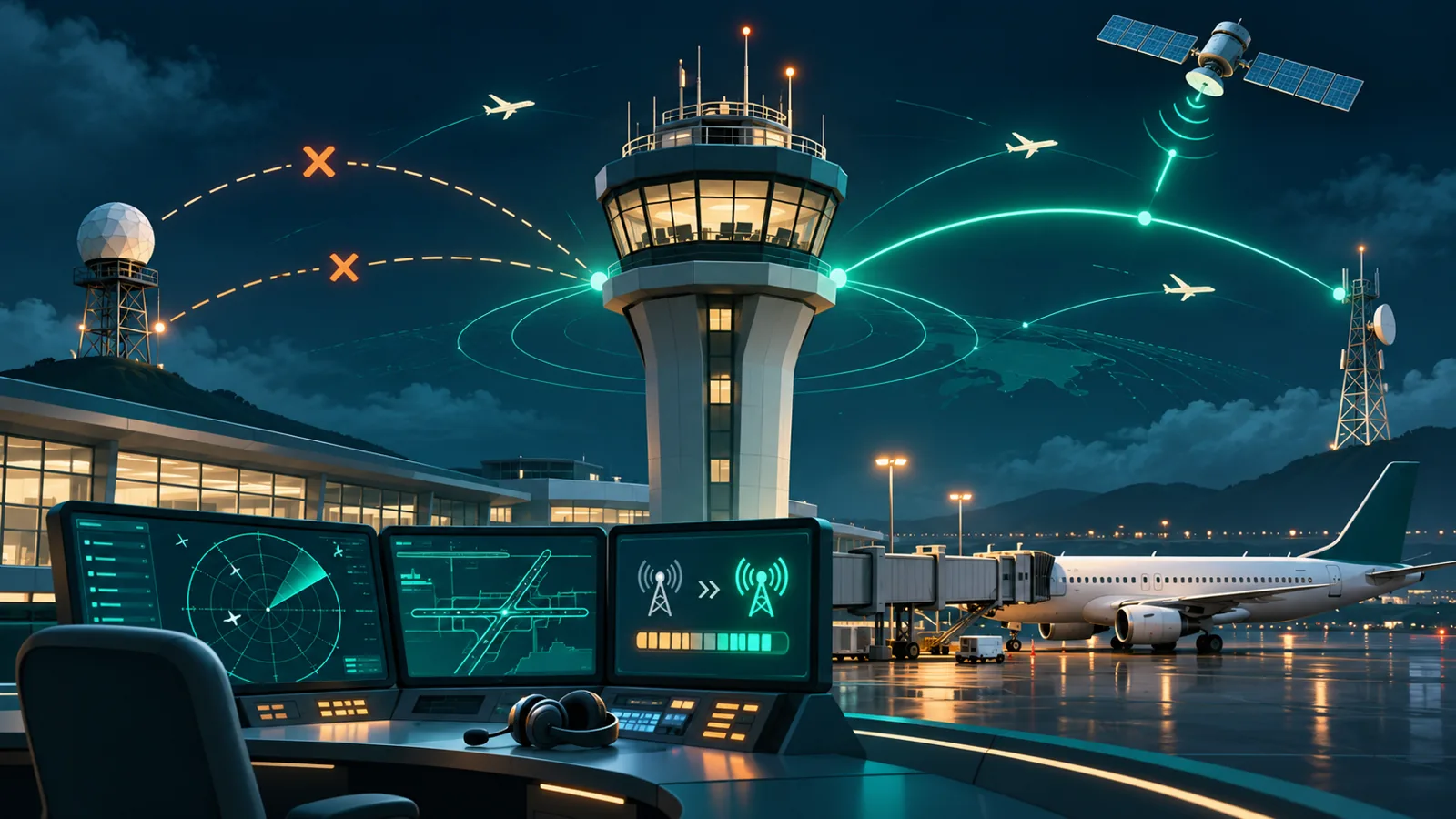
The FAA issued its national ground-stop advisory at approximately 3:54 PM Eastern Time, citing extraordinary circumstances and safety concerns. The problem affected communications at regional Air Route Traffic Control Centers, the facilities responsible for managing aircraft travelling between airports.
The incident is significant beyond the aviation industry. It demonstrates how a failure in a communications layer can disrupt an entire national transportation network, even when aircraft, airports and individual airline systems remain operational.
What happened on 13 November?
The disruption first appeared in Chicago, where traffic restrictions were imposed at O'Hare and Midway airports because of communications problems.
The situation subsequently escalated into a nationwide ground stop.
The FAA's national advisory instructed aircraft operators to keep departing traffic on the ground until further notice. International arrivals were to be handled individually. Aircraft already airborne were accounted for and were permitted to continue toward landing under the instructions available to controllers.
A ground stop is different from an instruction to cancel every flight. It is a traffic-management restriction that prevents new departures while the aviation system addresses a safety or capacity problem.
This distinction is important because aircraft already in the air still need to land safely, and airlines must manage aircraft positioning, passenger connections and airport capacity while departures remain restricted.
How large was the disruption?
The incident affected domestic and international travel, as well as cargo operations.
The Associated Press reported that by approximately 5:50 PM Eastern Time, at least 600 flights had been diverted. It also reported that around 11,000 flights carrying more than 1.5 million passengers had been scheduled to depart US airports after 4 PM. These figures describe the reported situation at that particular time, not a final count of flights affected solely by the ground stop.
Reuters separately reported that airlines had canceled more than 1,000 flights and delayed nearly 10,000 by the time of its reporting update.
The disruption also affected international operations. Some Pacific-bound departures were permitted to continue, while European and Mexican aviation authorities introduced restrictions on certain US-bound flights. Cargo companies faced uncertainty because the ground stop also affected departures carrying packages and freight.
Why communications infrastructure is so important
Air Route Traffic Control Centers manage aircraft as they travel between airports. They coordinate routes, separation and handoffs between different areas of controlled airspace.
Airports and airlines depend on these facilities to maintain safe and orderly flight operations.
A communications outage can therefore become a national-level problem even if it does not physically damage aircraft or airport facilities.
The system has to account for several connected components:
- Communications between controllers and aircraft.
- Data connections between regional control facilities.
- Operational coordination between controllers.
- Radar and other surveillance information.
- Flight-plan and traffic-management systems.
- Backup communications and contingency procedures.
When controllers cannot reliably communicate with aircraft, allowing additional departures could increase the number of aircraft that the system must manage under degraded conditions.
The ground stop is a conservative response to that risk.
What caused the outage?
At the time of this briefing, the precise technical root cause had not been established in the verified official and independent reporting.
Transportation and homeland-security officials described the incident as a telecommunications problem and said there was no indication at that stage that it was a deliberate attack. That does not constitute a completed forensic investigation or a definitive explanation of the failure.
The incident also attracted attention because the FAA had recently expanded its AI-supported Strategic Management of Airspace, Routes and Trajectories (SMART) system.
However, the available reporting did not establish a connection between SMART and the communications failure. The system's developer, Air Space Intelligence, said the outage was not caused by its product or its integration with the FAA.
It would therefore be inaccurate to describe this as an AI-system failure.
Status at publication
As of 6:16 AM IST on 14 November, the latest verified reporting had not established the root cause or confirmed a definitive restoration of normal operations. The published advisory's event window extended to 11 PM Eastern Time on 13 November, equivalent to 9:30 AM IST on 14 November, but its wording required departures to remain grounded until further notice. That time window should not be treated as a guaranteed resumption time.
What the incident reveals about infrastructure resilience
The United States has been working to modernize its air-traffic control technology.
Reuters reported that the administration and FAA were seeking an additional $30.1 billion for modernization, while Congress had previously approved $12.5 billion for upgrades. The incident has renewed attention on the reliability of older infrastructure and the difficulty of upgrading systems that must operate continuously.
For technology and infrastructure organizations, the lessons are broadly applicable.
1. Design for partial failure. Critical services should continue operating safely when one communications provider, route or system component becomes unavailable.
2. Test failover mechanisms. Redundant connections are useful only when they are independent and have been tested under realistic conditions.
3. Maintain degraded operating modes. Systems should have clearly documented procedures for continuing essential operations with reduced capabilities.
4. Control production changes. Maintenance and network changes in critical infrastructure need staged rollouts, explicit approvals and rollback procedures.
5. Monitor dependencies across organizations. A company may operate its own application correctly while depending on a separate network or service provider that experiences an outage.
What to watch next
The most important next development will be the technical investigation into the telecommunications failure, including whether the issue originated in a network provider, equipment failure, configuration change or another cause.
The FAA's explanation, any subsequent advisory changes and the impact on weekend airline schedules will be important indicators of how quickly the network can return to normal operations.
For technology leaders, the incident reinforces a fundamental principle: the reliability of a critical service depends not only on its software, but also on the communications, infrastructure and operational processes underneath it.
Why this is trending
- Hacker News: The FAA story reached the front page. At the time of retrieval, the discussion had approximately 1,183 points and 710 comments. Discussion focused on communications-network resilience, the age of aviation infrastructure, operational change management and the consequences of deploying changes in mission-critical systems. Some comments discussed possible network-provider and router explanations, but these were not treated as confirmed causes.
- daily.dev: The outage appeared in the Highlights feed approximately two hours before retrieval.
- Reuters and AP: Both provided substantial reporting on the nationwide ground stop and its operational consequences.
- Reddit: No reliable new topic-specific discussion with meaningful engagement data was verified.
- X: Direct search access was unavailable; no engagement figures are claimed.
- TechCrunch: No matching dedicated report was identified in the retrieved feed.
The strongest verified community signal is Hacker News, supported by the developer-news feed and major news reporting.
Sources
- FAA — Air Traffic Control System Command Center Advisory Database — 13 November 2026. Official source for air-traffic management advisories, including national ground-stop notices.
- Reuters — Flights grounded across US after air-traffic communications outage — 13 November 2026. Independent reporting on the outage, ground stop and infrastructure context.
- Associated Press — The Latest: FAA grounds all flights nationwide due to communications problems — 13 November 2026, with subsequent live updates. Operational impact, affected flights and official statements.
- Delta — Statement on FAA nationwide ground stop — 13 November 2026. Airline statement confirming operational restrictions and passenger guidance.
- Hacker News — FAA issues national ground stop — 13 November 2026. Community discussion and time-of-retrieval engagement snapshot.
Further reading
- FAA — Air Traffic Control System Command Center Advisory Database — 13 November 2026. Official source for air-traffic management advisories, including national ground-stop notices.
- Reuters — Flights grounded across US after air-traffic communications outage — 13 November 2026. Independent reporting on the outage, ground stop and infrastructure context.
- Associated Press — The Latest: FAA grounds all flights nationwide due to communications problems — 13 November 2026, with subsequent live updates. Operational impact, affected flights and official statements.
- Delta — Statement on FAA nationwide ground stop — 13 November 2026. Airline statement confirming operational restrictions and passenger guidance.
- Hacker News — FAA issues national ground stop — 13 November 2026. Community discussion and time-of-retrieval engagement snapshot.
Building a product in this space?
MORE FROM THE NEWSROOM
Related news
 Technology
ULA's Vulcan Rocket Fails to Deliver 40 Amazon Leo Satellites to Orbit
United Launch Alliance's Vulcan rocket suffered an in-flight anomaly approximately 10 minutes after liftoff on 15 November, failing to deliver 40 Amazon Leo broadband satellites into orbit. The incident represents ULA's first total mission failure and could complicate Amazon's already demanding satellite deployment schedule.
 Technology
AMD Plans Investment in PsiQuantum as Companies Expand Quantum Computing Partnership
AMD and PsiQuantum have expanded their strategic partnership to develop the classical computing infrastructure required for utility-scale, fault-tolerant quantum computers. The collaboration brings together AMD's CPUs, GPUs, adaptive computing technologies and software with PsiQuantum's photonic quantum computing platform, while AMD also plans to make an equity investment.
 Technology
X Launches Native Video Clipping, Giving Creators and Clippers New Ways to Earn Rewards
X has introduced a native video clipping feature that allows users to extract short segments from longer videos and share them with their own commentary. The feature also connects clipping activity to X's Original Content Rewards program, creating additional monetization opportunities for eligible creators and users who share clips.