Overview
AI meeting assistants have become common in workplace software, but many rely on cloud services to process recordings, transcripts and meeting notes. That creates a trade-off for users who want the convenience of automated summaries but are reluctant to upload sensitive conversations to another service.
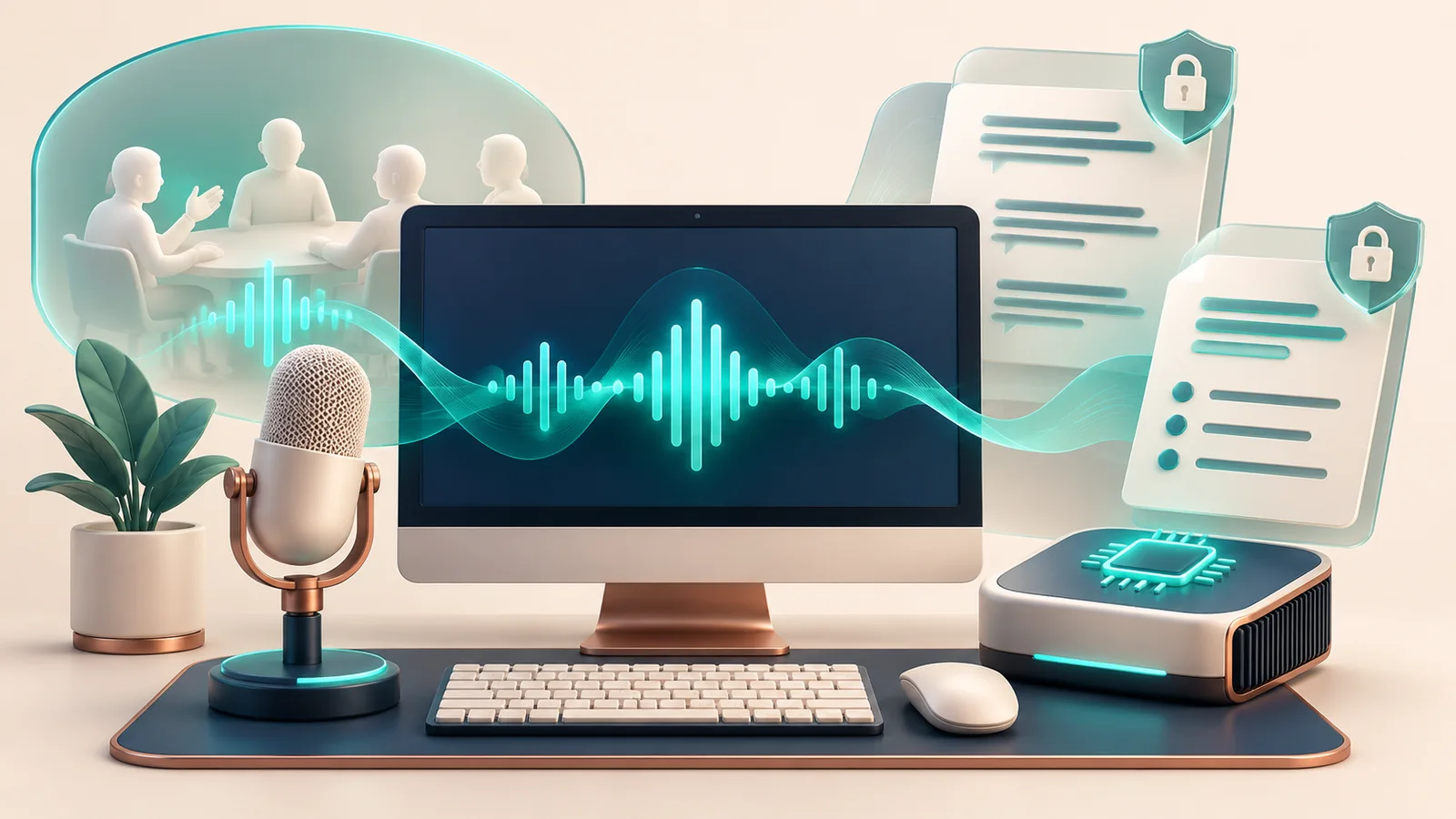
An open-source desktop application called Yogurt, developed by Frigade, is taking a different approach. The project provides AI-powered meeting transcription, summaries and question-answering while keeping the main recording and model-processing workflow on the user's own computer.
The application was introduced to the developer community through Hacker News on 11 November 2026. Its approach combines established local AI technologies with a desktop application designed for Windows, macOS and Linux.
How Yogurt works
Yogurt is built using Electron, allowing the developer to distribute a desktop application across multiple operating systems.
Its processing pipeline has three main stages:
- Recording: The application captures microphone input and the audio playing on the computer.
- Transcription: It uses
whisper.cppto convert speech into text. On supported Macs, Apple's SpeechAnalyzer can also provide live transcription. - Summarization and questions: A local open-weight language model runs through
llama.cppto generate meeting summaries and answer questions about recorded discussions.
The application does not need to add a bot to the video conference. Instead, it records the audio locally from the user's computer.
According to the project's documentation, Yogurt can record calls in different applications because it captures microphone and system audio. It can detect meetings in Zoom, Microsoft Teams and Google Meet, with some speaker-identification functionality limited to supported macOS environments.
Local AI is the central design decision
The main differentiator is that Yogurt does not require a paid cloud service or an account to perform its primary transcription and summarization workflow.
Its documentation says recordings, transcripts and notes remain stored locally. After the initial model downloads, transcription and summarization can run offline.
The project also automatically selects a model based on the user's hardware. Its documentation lists models from the Gemma, gpt-oss and Qwen3 families for summaries and questions, with llama.cpp providing the local inference layer.
This is an important design choice for users who do not need a frontier model to summarize an ordinary meeting. Smaller local models may be sufficient for extracting decisions, action items and key discussion points.
The application also supports multi-language transcription, with the project documenting support for 99 languages. English is the default, and users can change the spoken-language setting.
MCP support connects local notes to other AI tools
One of the more interesting developer-oriented features is its local Model Context Protocol server.
Yogurt can expose meeting notes and transcripts to a compatible assistant application, allowing users to query their meeting history from other AI tools.
The integration is designed to be read-only. The external assistant can access meeting data when the user enables the feature, but the application documentation says it cannot modify the original meetings, notes or transcripts through this connection.
There are important security details, however. MCP access is disabled by default. On macOS and Linux, the application uses a socket in the user's profile folder with restrictive permissions. On Windows, it uses a named pipe with a randomly generated name for each launch.
The project also documents a limitation: it does not provide a separate per-application token. While access is enabled, other applications running under the same user account may be able to read the exposed meeting data.
Furthermore, an external AI application could send information it reads to its own online model. Keeping data local inside Yogurt therefore does not automatically guarantee that it will remain local after an external connector is enabled.
Hardware requirements and practical limitations
Local AI processing removes the need to upload recordings to a cloud service, but it transfers the computational workload to the user's machine.
Yogurt lists a minimum requirement of 8 GB of memory and supports:
| Platform | Documented requirement |
|---|---|
| macOS | macOS 14.4 or newer on Apple Silicon |
| Windows | Windows 10 version 2004 or newer, 64-bit |
| Linux | Ubuntu 22.04 or a comparable distribution, 64-bit |
The initial setup can also require substantial storage. The project says it downloads a smaller notes model of approximately 5 GB, followed by a larger model that may require 14 GB or more depending on the computer.
This means that users with older hardware, limited memory or restricted disk space may not get the same experience as users with newer systems.
Local processing also has trade-offs in inference speed, model quality and resource usage. A smaller model may be convenient and private but may not produce the same results as a large cloud-hosted model for complex discussions.
Privacy still requires responsible recording practices
Yogurt's local-first design can reduce exposure to third-party recording services, but recording a meeting still creates responsibilities.
The application captures microphone and system audio, so participants should be informed that a recording is taking place. The project documents recording reminders, but users remain responsible for obtaining any required consent and complying with applicable laws and workplace policies.
Users should also protect their computers, local recordings and backups. A file stored locally is not automatically safe from malware, unauthorized access to a device or accidental sharing.
The MCP integration deserves particular attention in business environments. Teams should enable access only when necessary and review which applications can read the exposed transcripts.
Why developers may find it interesting
Yogurt demonstrates how smaller open-weight models and local inference frameworks can be combined into a useful desktop application without relying on a hosted AI subscription.
For developers, its architecture is also an example of how several open-source components can be assembled into a practical AI product:
- Electron for cross-platform desktop distribution.
- whisper.cpp for local speech recognition.
- Apple SpeechAnalyzer on supported Macs.
- llama.cpp for local language-model inference.
- MCP for controlled integration with other AI applications.
The project is released under the MIT license, making its source code available for inspection, modification and reuse under the license's terms.
What to watch next
The most important questions will be how the application performs on lower-powered machines, how its model-selection logic evolves, and whether its MCP integration gains more granular access controls.
The wider local AI ecosystem is also worth watching. If small models continue improving, more everyday workflows may be handled locally without requiring a cloud API for every operation.
Yogurt is still a developing project rather than a mature enterprise recording platform, but its launch highlights a growing developer interest in AI tools that combine practical functionality with user-controlled data storage.
Why this is trending
- Hacker News: The Show HN thread had 257 points and 96 comments at the time of research. The discussion covered local privacy, multi-platform support, competing meeting tools and the need to inform participants when recording.
- GitHub: The repository showed approximately 627 stars at the time of retrieval, alongside its public source code, MIT license and platform documentation. This is a point-in-time repository snapshot.
- Developer interest: The discussion included comparisons with other local meeting-note applications and questions about transcription quality, speaker identification and integrations.
No verified Reddit, X or daily.dev topic-level engagement was available. The Hacker News discussion is the primary community signal for this selection.
Sources
- FrigadeHQ/yogurt — GitHub repository — Frigade, project documentation available 12 November 2026. Primary source for the app's architecture, features, platform support, privacy model, hardware requirements and license.
- Show HN: Yogurt — Free, private, open-source alternative to Granola — Hacker News, 11 November 2026. Original developer announcement and community discussion.
Further reading
- FrigadeHQ/yogurt — GitHub repository — Frigade, project documentation available 12 November 2026. Primary source for the app's architecture, features, platform support, privacy model, hardware requirements and license.
- Show HN: Yogurt — Free, private, open-source alternative to Granola — Hacker News, 11 November 2026. Original developer announcement and community discussion.
Building a product in this space?
MORE FROM THE NEWSROOM
Related news
 Developer Tools
Brave Search API Adds USDC Per-Request Payments for AI Agents Through x402
Brave has introduced pay-as-you-go access to its Search API using the open x402 payment protocol. Developers and AI agents can now pay $0.005 per request in USDC on the Base blockchain, removing the need for a conventional account and API key on this payment route.
 Developer Tools
Anthropic Opens Self-Hosted Claude Managed Agents, Giving Enterprises Control of Agent Infrastructure
Anthropic has opened a private beta allowing organizations to run the full Claude Managed Agents infrastructure in their own cloud or on-premises environment. The move gives enterprise teams more control over agent credentials, session history and execution infrastructure, although requests to Claude still go to an external inference provider.
 Developer Tools
Rust 1.100 Stabilizes the Never Type and Custom Allocator APIs, Adds Cargo Dependency Safeguards
The Rust project has released Rust 1.100, bringing several long-awaited language and standard-library improvements. The release stabilizes the never type and core custom allocator APIs while introducing Cargo dependency checks and configurable dependency cooldowns that can help developers reduce supply-chain risk.