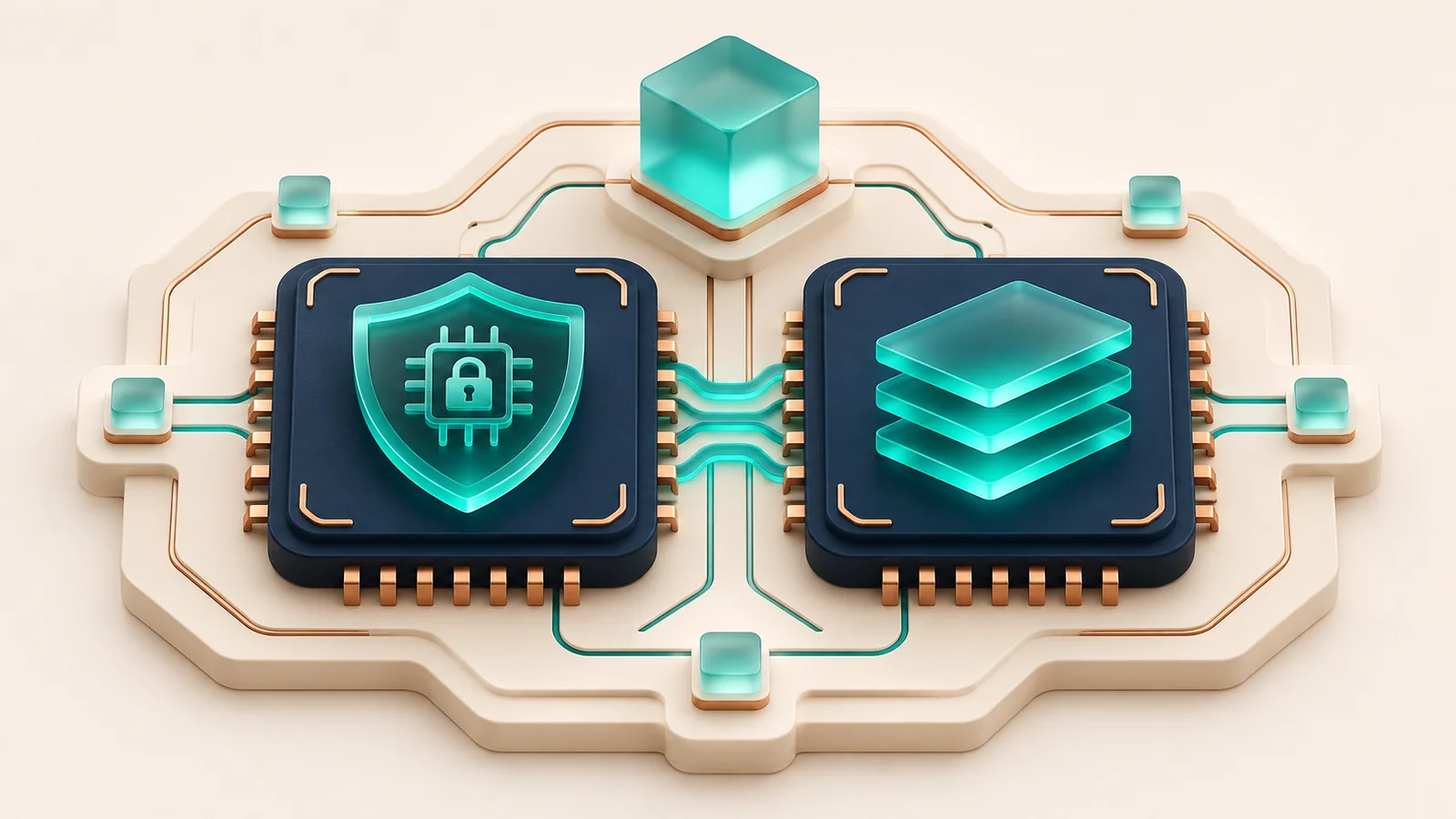
The announcement in one look
Google announced two new accelerator systems on November 10, 2026, in a post by Amin Vahdat, Chief Technologist and SVP of AI & Infrastructure: TPU 8i Max, built for massive context windows and the highest compute density per rack, and TPU 8tx, built for secure and confidential inference. With the additions, Google has introduced four TPU systems in a single year — which the company says is a first.
The new pair extends a generation Google started at Cloud Next in April 2026, where it introduced TPU 8t for large-scale training and TPU 8i for real-time reasoning. Those baseline chips offered up to 2.7 times better training performance and 80% better inference price performance respectively against the previous generation.
The market backdrop makes the timing significant, and it is worth separating fact from framing: Google's own announcement sells specialization and openness, not rivalry — but the rollout lands directly in Nvidia's dominant segment of the AI accelerator market, and TPU momentum is real. Google says TPUs now serve nearly 100 customers including frontier labs, trading firms, retailers, and universities. Earlier this quarter, Oracle announced it will become the first hyperscaler to offer Google TPUs outside Google Cloud, with Oracle Cloud Infrastructure availability planned for 2027 — the kind of distribution deal that intensifies the broader share contest. The competitive framing in headline coverage is editorial context rather than a claim Google makes in its announcement.
Why two more systems instead of one new chip
Google is explicit about the distinction: a chip takes a multi-year, physics-bound manufacturing cycle, while a system — the compute, networking, memory, and security arranged around the chip — can be reconfigured in months. By architecting TPUs as building blocks inside its AI Hypercomputer, Google says it can assemble specialized supercomputers quickly enough to keep up with agentic workloads, which have created demand for exactly two things this generation did not serve: hardware-level data security and million-token context scale.
TPU 8tx: confidential computing for regulated AI
TPU 8tx is optimized for secure and confidential inference and is also capable of small-scale training. Google is positioning it for regulated enterprises and governments that run frontier or proprietary models — and autonomous agents — alongside their most sensitive data. Normally, data is encrypted at rest and in transit but has to sit unencrypted in memory while a computer processes it. TPU 8tx builds protection into the hardware layer itself, keeping sensitive data and model weights protected and isolated even while in active use.
- Built on the same silicon as TPU 8t, paired with 5th Generation AMD EPYC CPU hosts.
- Adopts the low-latency Boardfly network Google created for real-time reasoning.
- Delivers up to 2× lower latency compared with TPU 8t, with a near-zero performance penalty.
- Supports fine-tuning on private data, distilling large models into smaller ones, and reinforcement learning — all on one system, without migrating sensitive data between clusters.
That last point changes procurement math for regulated teams. Training-grade compute combined with a fast inference network means an organization can customize and serve its models on the same system where the data already lives — removing a migration step that, until now, was often a hard blocker for finance, healthcare, and government workloads.
TPU 8i Max: attacking the memory wall
TPU 8i Max targets a different bottleneck: memory bandwidth. When dozens of agents work across an entire codebase or hours of video simultaneously, memory bandwidth becomes the constraint. Google's answer is packaging — it combined two low-latency TPU 8i chips onto a single package so compute and memory scale in lockstep.
- Double the compute of TPU 8i from the dual-chip packaging.
- Double the SRAM and double the HBM bandwidth versus TPU 8i.
- Twice the silicon within the existing rack footprint — roughly doubling the computing power deployable per square foot and per watt.
- Aimed at million-token context agents, with massive context windows and the highest compute density per rack in the portfolio.
Density gains compound quietly: because 8i Max fits the same form factor racks, operators can add capacity without new real estate or power envelopes — a meaningful constraint given that data-center siting, not chip supply, is often the limiting factor for at-scale inference.
The eighth-generation lineup so far
| System | Introduced | Role |
|---|---|---|
| TPU 8t | April 2026 (Cloud Next) | Training powerhouse for massive foundation models, optimized for goodput — useful intelligence delivered per watt. |
| TPU 8i | April 2026 (Cloud Next) | Real-time reasoning engine; cuts inter-chip communication delays by up to half. |
| TPU 8tx | November 10, 2026 | Secure and confidential inference plus small-scale training for regulated workloads. |
| TPU 8i Max | November 10, 2026 | Massive context windows and the highest compute density per rack. |
Together, the four systems give customers a purpose-built accelerator for every stage of the agentic lifecycle in Google's framing — scale-up training, low-latency reasoning, confidential computing, and massive-context serving.
What ships alongside the silicon
Google framed the hardware alongside a software push intended to make TPUs usable with everyday developer tooling. The pieces are individually verified from the announcement and Google's recent posts:
- TorchTPU, open-sourced last month, so native PyTorch code and Hugging Face models run on TPUs without rewrites, with out-of-the-box backends for vLLM and SGLang.
- A TPU agent suite, now in preview, that plugs into coding tools including Claude Code, Cursor, and Google Antigravity to automate onboarding, diagnose bottlenecks, and autotune kernels using plain language.
- An open-source XLA Serving Engine that lets teams train models in Python and serve them in a low-latency C++ runtime across TPUs, GPUs, and CPUs.
- TPU Sync, a new open-source model-state layer that tiers chip HBM, host DRAM, storage, and the data-center network into one memory hierarchy — cutting KV-cache transfer latency and time-to-first-token by more than 90% for agentic and reinforcement-learning loops.
- Cloud Pathways, the runtime behind Google DeepMind's Gemini, now generally available on GKE with a single-controller architecture for orchestrating multi-slice TPU systems.
- GKE dynamic slicing, generally available, which uses optical circuit switching to assemble or partition TPU topologies on demand — slashing job startup times by up to 5× and accelerating fault recovery by up to 4.5×.
On performance claims, Google cites third-party SemiAnalysis evaluations directly — the InferenceX and AgentX benchmarks that test realistic agentic coding and long-context work — where its native vLLM-TorchTPU stack achieved state-of-the-art price-performance, with results that extend across frontier open models.
Why this story is trending
- Four TPU systems in one year is an unprecedented release cadence for Google's accelerator line, and a signal of how fast agentic workloads are reshaping hardware roadmaps.
- Confidential computing moves from a GPU-checkbox feature to the TPU portfolio — directly aimed at regulated industries that have struggled to run sensitive frontier workloads in the cloud.
- The Oracle deal announced in October — making Google TPUs available through Oracle Cloud Infrastructure in 2027 — breaks TPUs out of Google-only distribution for the first time.
- Amid Nvidia's dominance of AI accelerators, price-performance wins reported on industry benchmarks give procurement teams an additional credible negotiating path.
- The dual-chip TPU 8i Max design answers the most concrete agentic-era constraint: million-token contexts and memory bandwidth, the same bottlenecks developers hit when wiring large agents to production data.
What to watch next
- Detailed TPU 8tx and 8i Max pricing and regional availability, which Google has not published in the announcement.
- Deployment details of the Oracle Cloud TPU offer planned for 2027 — including which system generations Oracle will carry.
- Adoption of TorchTPU and the XLA Serving Engine, and whether the no-rewrite PyTorch path meaningfully shifts multi-cloud accelerator mixes.
- New published pricing-performance data on InferenceX and AgentX as software optimizations land on the same hardware.
- Competitive responses in the confidential-computing lane, where regulated AI workloads are shaping into a distinct purchasing segment.
Further reading
Building a product in this space?
MORE FROM THE NEWSROOM
Related news
 Artificial Intelligence
US Moves to Regulate Remote Access to Advanced AI Chips Through Overseas Data Centers
The US Department of Commerce has released an interim final rule targeting remote access to advanced American semiconductors through overseas data centers. The measure introduces licensing requirements for certain high-volume computing arrangements serving companies headquartered in restricted destinations and adds destination-based controls for advanced chip exports to five countries.
 Artificial Intelligence
OpenAI Launches ChatGPT Wallet, Letting AI Agents Complete Purchases With User Approval
OpenAI has introduced ChatGPT Wallet, a payment feature that allows its AI agents, called Dots, to complete online purchases after users review and approve each transaction. Developed with American Express, Mastercard and Visa, the initial rollout is limited to eligible US ChatGPT Pro subscribers.
 Artificial Intelligence
Cerebras Raises 2026 Revenue Outlook After 55% Quarterly Growth, but GAAP Losses Widen
AI hardware company Cerebras reported record third-quarter revenue of $210.8 million and raised its full-year 2026 revenue outlook. Its cloud and inference business grew rapidly, but the results also revealed a much larger GAAP net loss, highlighting the financial challenges of scaling advanced AI infrastructure.