Overview
India's semiconductor startup ecosystem has received another important funding boost as Bharat Semi raises $24 million in seed financing to develop a new generation of AI-enabled image sensors.
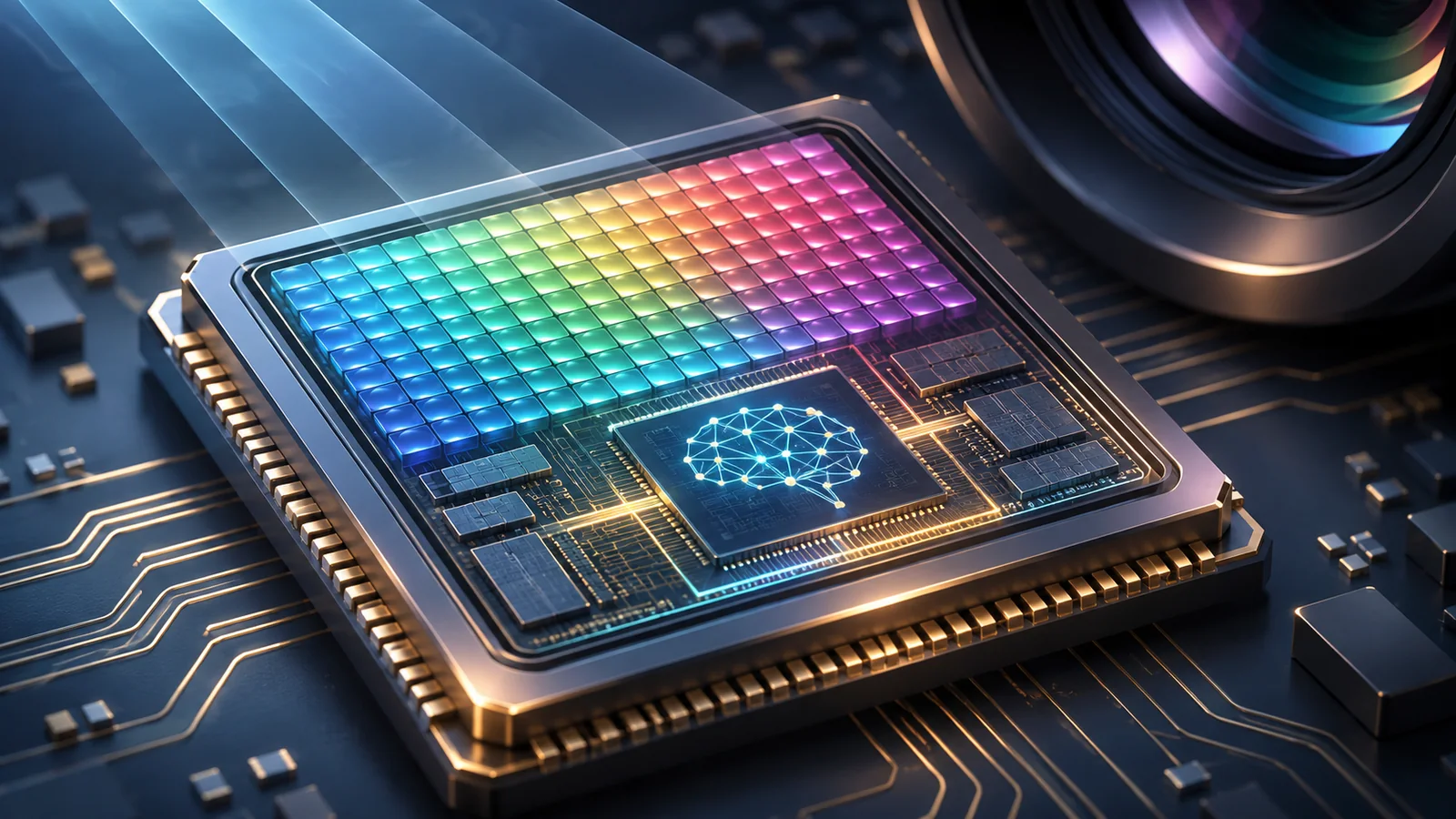
The New Delhi-based company is developing programmable sensors designed to combine image capture, image processing and AI capabilities within a single chip.
The objective is to reduce the need for separate processing components in devices that rely on computer vision.
The funding announcement was reported by TechCrunch on 15 November 2026 and subsequently covered by Indian business publications on 16 November. The company is targeting global customers, particularly in the United States and Europe, while continuing to develop its semiconductor products in India.
What is Bharat Semi building?
Traditional computer-vision systems commonly rely on multiple hardware components.
A typical architecture can include:
- An image sensor to capture visual information.
- An image signal processor to process the captured data.
- A separate system-on-chip or processor to execute AI workloads.
This architecture can introduce additional hardware complexity, power consumption and data movement.
Bharat Semi is developing programmable image sensors intended to combine these functions into a more integrated chip.
Traditional computer-vision architecture
Image sensor
Captures visual information
Image signal processor
Processes image data
Separate AI processor / SoC
Executes additional processing
Bharat Semi's intended architecture
Integrated programmable image sensor
Image capture + processing + AI capabilities within one chip
Conceptual architecture based on the company's product description, not a verified silicon die or production specification.
The approach is particularly relevant for edge computing, where devices need to interpret visual information without continuously transferring large amounts of raw image data to separate processors.
The potential applications
Bharat Semi is targeting several industries where image processing is an important part of the underlying product.
| Industry | Potential application |
|---|---|
| Smart homes | Devices that detect occupancy and adapt their behaviour |
| Industrial automation | Visual inspection and machine monitoring |
| Surveillance | More efficient local image processing |
| Aerospace | Vision systems for specialised equipment |
| Drones | Visual processing with less dependence on external computing hardware |
One example described by co-founder Vrinda Kapoor involves air-conditioning systems that can detect whether a room is occupied and automatically adjust their operation.
Another potential application is drone technology, where processing visual information locally could reduce dependence on more expensive external computing components.
These are intended applications, not proof that the company's products have already reached commercial deployment.
How much funding has the startup raised?
Bharat Semi secured $24 million in an all-equity seed funding round.
The round was led by:
- Info Edge Group.
- South Park Commons.
- Indus Bridge Ventures.
Other participants included Valour Capital, Micromax, Gaingels and individual investors.
The company plans to use the capital to expand its engineering workforce, complete product development and prepare its sensors for commercial markets.
According to TechCrunch, the startup had approximately 75 employees across India and the United States at the time of reporting.
What about its claimed 70% cost reduction?
One of the more interesting claims in the announcement concerns potential hardware cost savings.
Co-founder Vrinda Kapoor told TechCrunch that integrating image capture, processing and AI capabilities could reduce system costs by at least 70% compared with conventional configurations using separate image sensors, image signal processors and system-on-chip components.
This is a company claim, not an independently verified benchmark.
The actual savings will depend on the final sensor design, manufacturing yield, production volume, power requirements and the additional software or hardware required by customers.
For developers building computer-vision applications, the broader idea is still significant: processing visual information closer to where it is captured could reduce data-transfer requirements and simplify certain hardware designs.
The development roadmap
Bharat Semi is still an early-stage, pre-revenue business.
Its products remain under development.
The roadmap described by the co-founder includes:
| Milestone | Expected timing |
|---|---|
| First-generation sensors | Prototyping underway |
| Initial commercial production | 2027 target |
| Second-generation sensor prototypes | Mid-2027 target |
| Second-generation customer availability | End of 2027 target |
These are management's stated development targets, not guaranteed commercial release dates.
The company has also reported design wins involving US defence technology company General Atomics and India's Kaynes Semicon.
However, the company has not publicly disclosed the full commercial terms, shipment volumes or production revenue associated with these design wins.
A design win should not be interpreted as a completed commercial deployment.
India's semiconductor opportunity
The investment is relevant to India's ambition to develop a stronger semiconductor design and manufacturing ecosystem.
India has attracted significant policy and private investment interest in semiconductor manufacturing, but the industry continues to face challenges involving manufacturing capacity, supply chains, engineering talent and specialised production infrastructure.
Bharat Semi's strategy is particularly interesting because it intends to remain fabless.
This means it plans to focus on semiconductor design and software while outsourcing actual chip manufacturing.
The company has previously discussed a separate semiconductor fabrication project involving a technology partnership with the US Space Force.
However, TechCrunch reported that this project remains under development and is separate from the image-sensor business. The new $24 million funding is not intended to finance that proposed fabrication facility.
What this means for developers and hardware companies
If Bharat Semi successfully commercialises its sensors, it could create opportunities for companies building:
- Edge AI devices.
- Smart-home automation.
- Industrial computer vision.
- Robotics platforms.
- Autonomous sensing systems.
- Surveillance equipment.
- Aerospace electronics.
Developers may eventually benefit from hardware platforms that require fewer external processing components.
However, actual adoption will depend on documentation, development tools, software compatibility, power efficiency, sensor performance and manufacturing availability.
What happens next?
The most important milestones are the completion of the first-generation sensors, validation by prospective customers and the company's ability to move from prototypes into commercial manufacturing.
The second-generation sensor roadmap will also be important because it is expected to incorporate more advanced AI capabilities.
Bharat Semi's $24 million raise is an interesting development for India's semiconductor design ecosystem. The real test will be whether the startup can convert its engineering ambitions and customer design wins into reliable, commercially deployed silicon.
Why this is trending
- TechCrunch: Published detailed coverage on 15 November at 3:30 PM PST, including the funding round, investor list, product architecture and co-founder interview.
- Mint: Reported the $24 million seed round on 16 November at 6 AM IST, including additional details about funding plans and the company's development stage.
- ET Enterprise AI: Published coverage on 16 November at 12:45 PM IST, highlighting the company's AI sensor strategy and reported design wins. Its report references TechCrunch.
- Reddit: No substantial matching community discussion verified.
- Hacker News: No matching front-page discussion found.
- X: No independently verified engagement figures retrieved.
- daily.dev: No matching current developer-community post verified.
The strongest evidence is the combination of technology reporting, company interview material and Indian business coverage. Cross-platform social traction has not been established.
Sources
- TechCrunch — Indian Chip Startup Bharat Semi Lands $24M Seed Round — 15 November 2026. Detailed founder interview and reporting on the funding, architecture, product roadmap and customer design wins.
- Mint — Bharat Semi Raises $24 Million in Seed Round — 16 November 2026, 6 AM IST. Indian business coverage of investors and funding plans.
- ET Enterprise AI — Bharat Semi Secures $24 Million — 16 November 2026, 12:45 PM IST. Additional coverage of the company's AI sensor strategy.
- Bharat Semi — Official Website — Company information and product background. A detailed standalone funding announcement was not independently retrieved.
Further reading
- TechCrunch — Indian Chip Startup Bharat Semi Lands $24M Seed Round — 15 November 2026. Detailed founder interview and reporting on the funding, architecture, product roadmap and customer design wins.
- Mint — Bharat Semi Raises $24 Million in Seed Round — 16 November 2026, 6 AM IST. Indian business coverage of investors and funding plans.
- ET Enterprise AI — Bharat Semi Secures $24 Million — 16 November 2026, 12:45 PM IST. Additional coverage of the company's AI sensor strategy.
- Bharat Semi — Official Website — Company information and product background. A detailed standalone funding announcement was not independently retrieved.
Building a product in this space?
MORE FROM THE NEWSROOM
Related news
 Startups
Fractal Analytics in Talks With 20–25 AI Startups as It Weighs Acquisitions
Fractal Analytics is evaluating potential acquisitions involving 20–25 AI startups as it expands its enterprise AI capabilities. CEO Srikanth Velamakanni says the company is particularly interested in healthcare AI, agentic AI and AI engineering businesses that can provide specialised talent and strategic relationships with major technology providers.
 Startups
Norwest Raises Record $4 Billion Fund, Expanding Investment in AI, Cybersecurity and Physical Technology
Norwest has announced a $4 billion investment fund, the largest in its 65-year history, taking its total capital under management to $18 billion. The global multi-stage investor plans to pursue opportunities across technology, healthcare and consumer businesses, with particular interest in AI infrastructure, physical AI, voice AI and cybersecurity.
 Startups
LangChain Raises $300 Million at a $3 Billion Valuation to Expand AI Agent Infrastructure
AI developer-tooling company LangChain has reportedly raised $300 million at a $3 billion valuation in a round led by Alphabet's CapitalG. The funding is expected to support expansion of LangSmith and the company's broader platform for building, evaluating and operating AI agents.